
I used to think outbound was mostly about writing a better email.
That was the comfortable version of the problem. If the email was bad, I could fix the email. If the subject line was weak, I could rewrite it. If nobody replied, I just needed a better template.
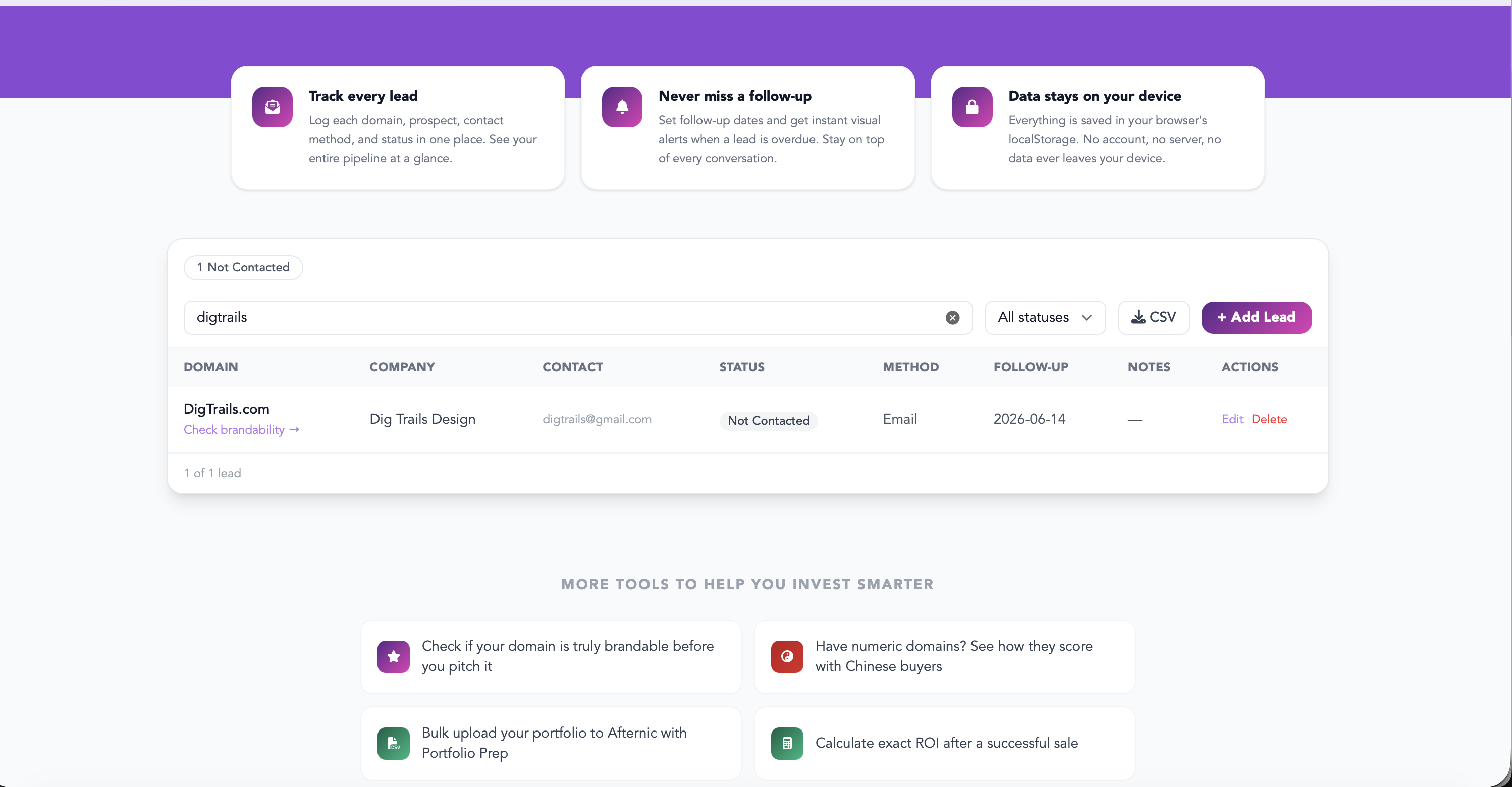
But when I started putting real prospects into a tracker, even with a small test like DigTrails.com, the problem became a bit more awkward.
Sometimes the email is not the weak part.
Sometimes the domain thesis is.
For example, I added a test lead for DigTrails.com into Domaincord's Outreach Tracker. The prospect was a small site called Dig Trails Design, using a Wix subdomain. On the surface, it looked like a possible fit. Similar wording. Outdoor/trail feeling. A weaker web address.
Then I had to write the note.
That is when the name became less obvious.
Is DigTrails.com really better for them? . Is "dig" clear enough for a trail/outdoor brand? not. Would they pay $500? . The tracker did not answer those questions for me, but it forced me to face them before sending a lazy message.
That is probably the biggest thing I am learning about outbound. A tracker is not just for remembering who I emailed. It also exposes weak thinking.
Start With The Uncomfortable Question
The first question I try to ask now is not:
Who can I send this domain to?
It is:
Who would feel a little pain if they did not own this domain?
I do not mean pain in a dramatic way. I mean something practical.
A company using a long, ugly, or platform-based URL might feel some pain. A funded startup launching a product in a category may feel some pain. A professional service business spending money on ads may feel some pain. A company already using the exact words in a worse domain might feel some pain.
A random business with one similar word in the name might not.
That difference matters more than I expected.
I have not done enough outbound to pretend I have a perfect reply rate or a repeatable sales system. I do not have a "I sent 43 emails and closed two deals" story yet. So this post is not that. This is more like the process I wish I had before I started thinking about outbound as only a message-writing task.
The Buyer Reason Has To Survive One Ugly Sentence
Before I add someone to a lead list, I try to write one sentence:
This buyer might care because...
If I cannot finish that sentence without forcing it, I usually should not send the message yet.
For a name like HomeworkBase.com, the sentence is easier than some random brandable:
This buyer might care because they are in education, tutoring, student tools, or homework help, and the domain sounds like a place where students return often.
That does not mean it is a buy. It only means the use case is not imaginary.
For CashlessPortal.com, the sentence is also possible:
This buyer might care because they build payments, merchant tools, checkout systems, or fintech dashboards, and the name sounds like access to a cashless system.
Again, not a guaranteed sale. But at least there is a commercial direction.
The names I struggle with are the ones where I can only say:
It sounds nice.
That is not enough for outbound. It might be enough for a long-hold brandable if the name is excellent, but outbound is more direct. If I cannot explain why this buyer should care today, I am probably just hoping they will like my taste.
Where I Would Look For Buyers
I do not think there is one perfect source for prospects.
For company and brandable names, I would start with Google, LinkedIn companies, Crunchbase, OpenCorporates, and similar-domain searches. I am looking for companies using weaker domains, longer names, hyphens, odd extensions, or platform URLs.
For local service names, Google Maps matters more. But I have become more careful there. A small local business is often not excited to pay much for a domain. If the domain only has one small buyer, I would be nervous. If the name can fit 100 dentists, roofers, clinics, law firms, or med spas in a city/region, that is different.
For personal names, LinkedIn is useful, but I no longer assume every person is a buyer. A common name can show a big pool, but most people will still not care. I would want to see founders, consultants, lawyers, creators, realtors, doctors, speakers, or people who actually benefit from personal branding.
The point is not to collect emails fast. The point is to avoid contacting people who were never realistic buyers in the first place.
The Contact Method Is Less Important Than Buyer Fit
I have seen different opinions from investors on this.
Some people still use cold email. Some prefer LinkedIn because it feels less anonymous. Some use contact forms. Some rely more on landers and marketplaces because outbound can be tiring and reply rates can be bad.
I do not think the method fixes a weak domain.
If the buyer fit is strong, even a simple message can work. If the buyer fit is weak, a polished message just makes the rejection look more professional.
For now, I would keep it simple:
- Email if there is a clear business email or contact page.
- LinkedIn if the buyer is a founder, owner, marketing person, or someone connected to brand decisions.
- Contact form if there is no better route.
- Marketplace or lander if I do not have a clear outbound list.
I would not blast everyone. That is tempting, especially when trying to make a quick sale, but it can also make the domain look cheap or spammy.
A Message I Would Actually Send
I would rather send something plain than something that sounds like a sales page.
For the DigTrails.com test, a rough version would be:
Subject: DigTrails.com

Hi [Name],

I noticed your site is related to trails/outdoor design, so I wanted to ask if DigTrails.com would be useful for your brand.

I own the domain and I am considering selling it. It may be cleaner than using a platform subdomain, but no worries if it is not relevant.

Best,
Vu
It is not fancy. it is still too soft. But it does one thing I like: it does not pretend the buyer asked for the domain.
I think that matters. Most businesses are not sitting around waiting for my email. If I write like I am doing them a favor, the message feels strange. Better to be direct, short, and easy to ignore.
Pricing Before Contacting Anyone
This is a small detail, but it changed how I think.
In the Domaincord tracker form, there is an asking price and a minimum acceptable price. When I filled the test row, I put:
Asking Price: 500
Minimum Acceptable Price: 495
That was mostly a test value, but the field itself is useful. It makes me decide before the conversation starts.
If my floor, I might negotiate emotionally. If I start too high for a weak buyer, I waste the lead. If I start too low for a strong buyer, I may leave too much money on the table.
For small outbound names, I currently think in ranges more than exact numbers:
- Cheap hand-reg or closeout with uncertain demand: low hundreds.
- Stronger name with multiple realistic buyers: mid to high hundreds, sometimes more.
- One obvious buyer only: be careful, especially if there is trademark risk.
- High-value business category: price can be higher, but only if the name and buyer pool support it.
Pricing is probably one of the hardest parts of domaining because the same domain can look cheap to one buyer and useless to another.
Why I Like A Boring Tracker
I like Domaincord's free Outreach Tracker because it is boring in the right way.
It does not promise to find buyers for me. It does not write magic emails. It does not make a weak domain good.
It just gives me a place to put the lead, the buyer, the method, the status, and the follow-up date.
That sounds basic, but basic is enough when the alternative is a messy note file and forgetting who I already contacted.
The tool saves data in the browser's local storage, so there is no account and no server-side CRM setup. That is nice for a simple workflow, but it also means I should export CSV if I care about the data. Local storage is convenient, not a backup strategy.
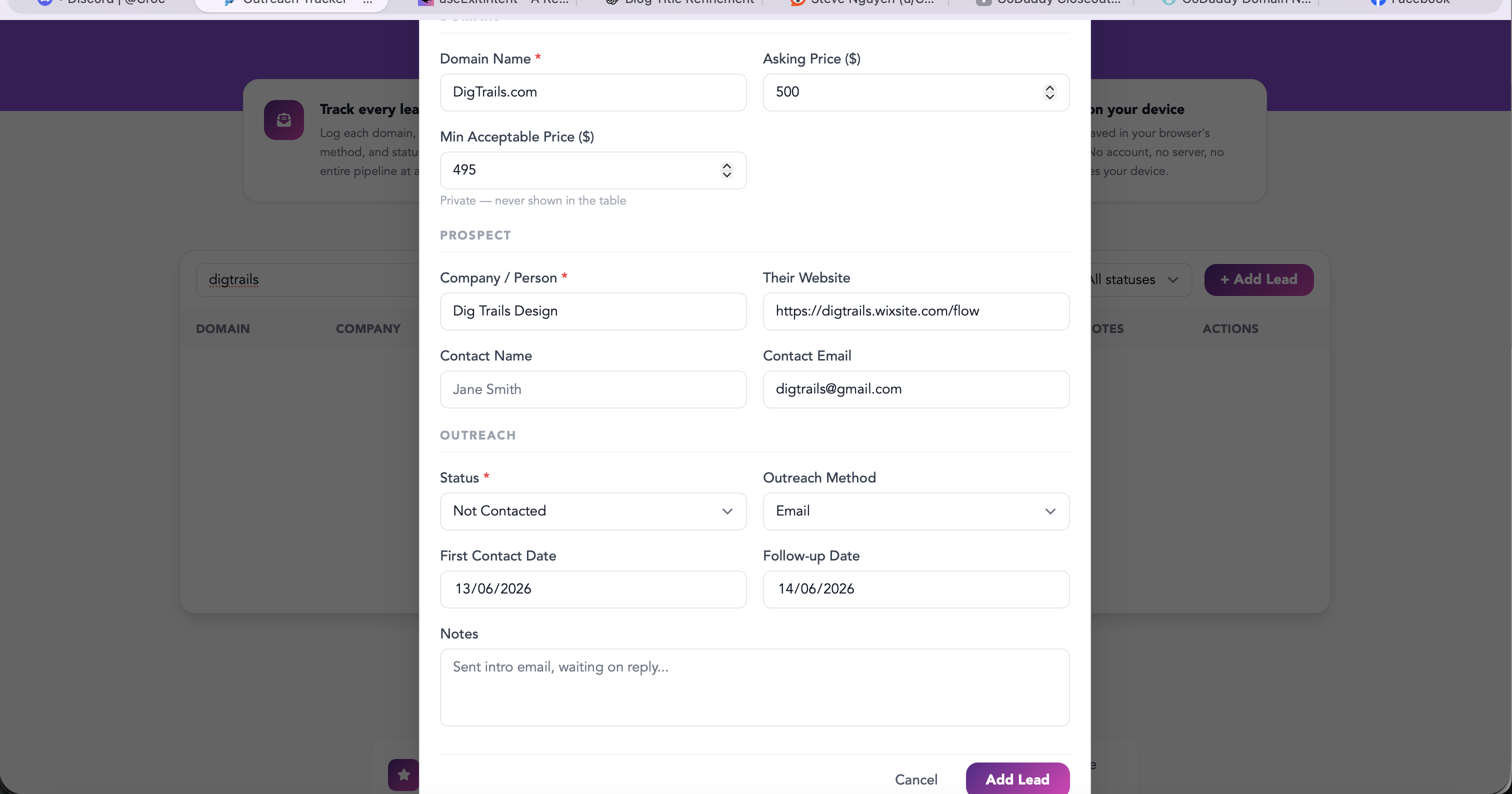
The fields I would actually use:
Domain Name: the domain I own or am testing.Asking Price: the public number I am willing to quote.Min Acceptable Price: my private floor.Company / Person: the prospect.Their Website: the current site or weaker domain.Contact Name: useful if I can find a real person.Contact Email: only if I have a reasonable contact.Status: not contacted, contacted, replied, follow-up, closed, no response.Outreach Method: email, LinkedIn, contact form, marketplace, phone, or other.First Contact Date: when I sent the first message.Follow-up Date: when I should check again.Notes: the reason this lead exists.
The notes field is the one I care about most.
If the note only says "possible buyer", that is too vague. I want the note to say something like:
Uses long domain. Exact service match. Active company. Likely small budget.
or:
Wix subdomain. Brand wording close, but fit is not perfect. Low confidence.
Those little notes prevent me from lying to myself later.
Follow-Up Without Becoming Annoying
I used to think follow-up was just "send another email later."
Now I think the follow-up decision should be made before sending the first message.
If the buyer is a strong fit, I might follow up once or twice. If the buyer is weak, not at all. If there is no reply after two short follow-ups, I would rather move on.
A simple follow-up could be:
Hi [Name],

Just checking once in case this got buried.

If DigTrails.com is not relevant, no problem at all.

Best,
Vu
Nothing dramatic. No fake urgency. No "last chance" pressure.
Most people are busy. Many do not care about domains. Some may care later. I do not want to burn the lead by sounding desperate.
A Few Notes I Would Keep Beside Me
This is the messy checklist I would use before sending outbound:
- If I cannot explain buyer fit in one sentence, do not send yet.
- Do not contact someone only because one word is similar.
- Check if the buyer has money or a real business reason to care.
- Write the floor price before the first message.
- Do not depend on one tiny buyer.
- Be extra careful with made-up names and trademark-looking names.
- Keep the message short.
- Track follow-ups.
- Stop after one or two follow-ups unless there is real engagement.
- Export the CSV if using a browser-local tool.
The ugly truth is that outbound can make a bad acquisition look even worse.
If I buy a weak domain and then cannot find real buyers, the problem was not outreach. The problem started before the purchase.
For me, the useful lesson is smaller:
Outbound forces discipline.
It forces me to ask who the buyer is, why they would care, how much they might pay, and whether the domain is actually better than what they already have.
That is helpful even if I never send the email.
Because if I cannot build a believable outbound list for a domain, I should ask why I bought it.