
A domain can look clean, short, and brandable.
But that does not automatically mean it is worth buying.
The question I am trying to answer is:
Can I name real buyers who might actually want this domain?
This post is my current workflow for moving from a brandable-looking domain into a buyer list and outreach tracker.
The goal is not only to find names that sound good. The goal is to find names that can survive buyer research.
Research Result First
I tested three example names through a brandability-first workflow:
| Domain | Brandability Score | First Read | Buyer-List Question | Next Action |
|---|---|---|---|---|
| DigTrails.com | 90% | Short, clean .com with a clear outdoor/data feel | Are there trail, map, route, hiking, travel, or GIS products that could use this? | Build a buyer list before assuming value |
| HomeworkBase.com | 87% | Clear education phrase, but slightly longer | Can tutoring, homework-help, worksheet, LMS, or study products use this? | Test buyer categories |
| TimelyReminder.com | 87% | Strong workflow phrase, but more generic | Can reminder, scheduling, CRM, health, or service businesses use this? | Compare buyer pool against competition |
My current takeaway:
Brandability is the first gate.
Buyer research is the second gate.
Outreach feedback is the real proof.
Step 1: Use a Brandability Check First
Before building a buyer list, I want to avoid obviously weak names.
For that first pass, I tested the names using the Domaincord Brandability Checker:
The checker is useful because it gives a quick read on simple brandability factors:
- domain length
- extension
- hyphens
- numbers
- common TLD recognition
- basic readability
It does not tell me the resale value of a domain.
It is only a first screen.
Example 1: DigTrails.com
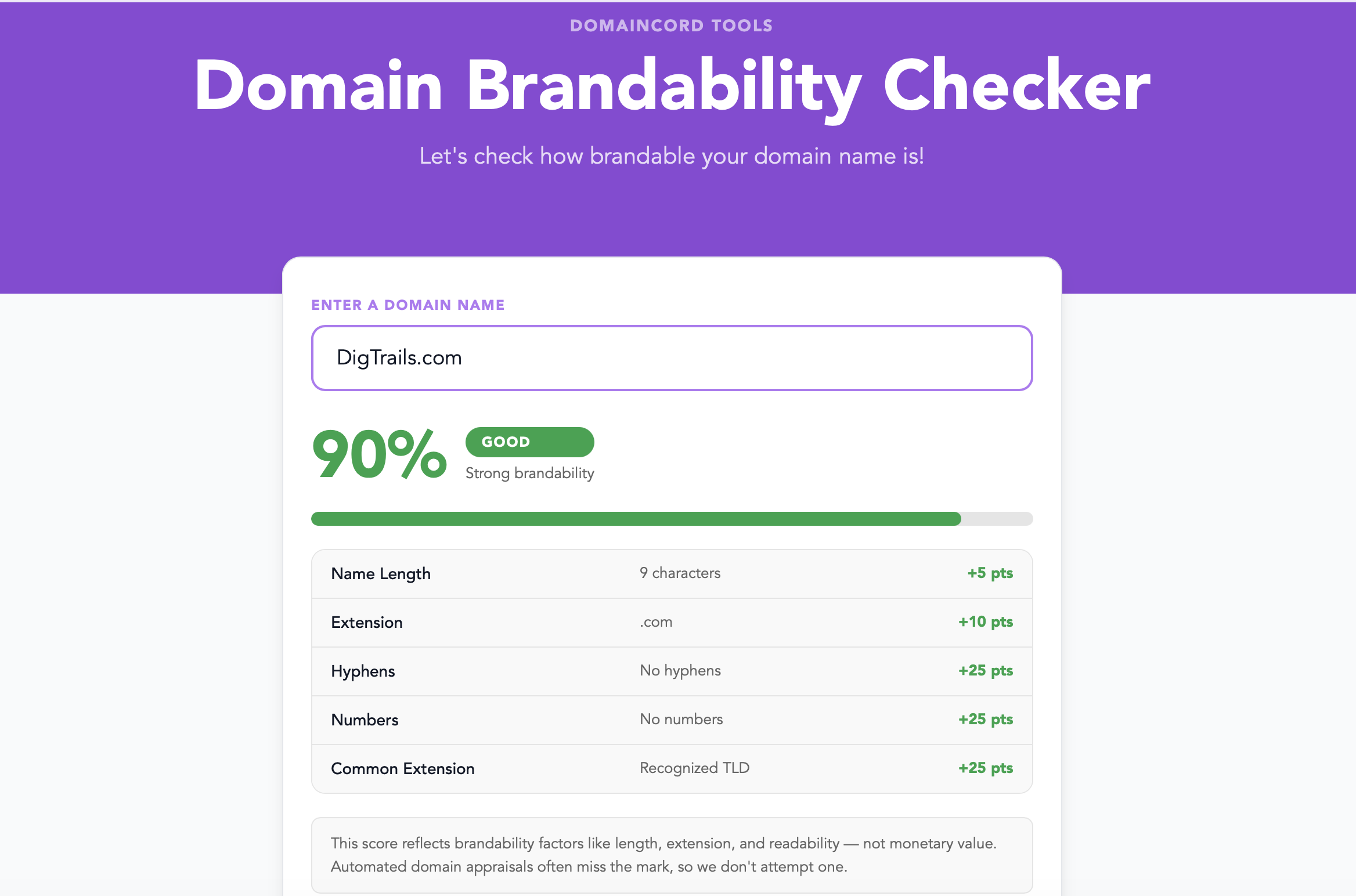
DigTrails.com scored 90%.
That makes sense because it is:
- short enough
- .com
- no hyphens
- no numbers
- easy to read
But the score alone is not enough.
The next question is:
Who would buy DigTrails.com?
Possible buyer categories:
- hiking app
- trail map product
- GIS / location-data tool
- outdoor travel guide
- local trail directory
- route discovery app
- outdoor content brand
If I can find real companies in those categories, then the domain becomes more interesting.
If I cannot find buyers, then the name is just a nice-sounding idea.
Example 2: HomeworkBase.com
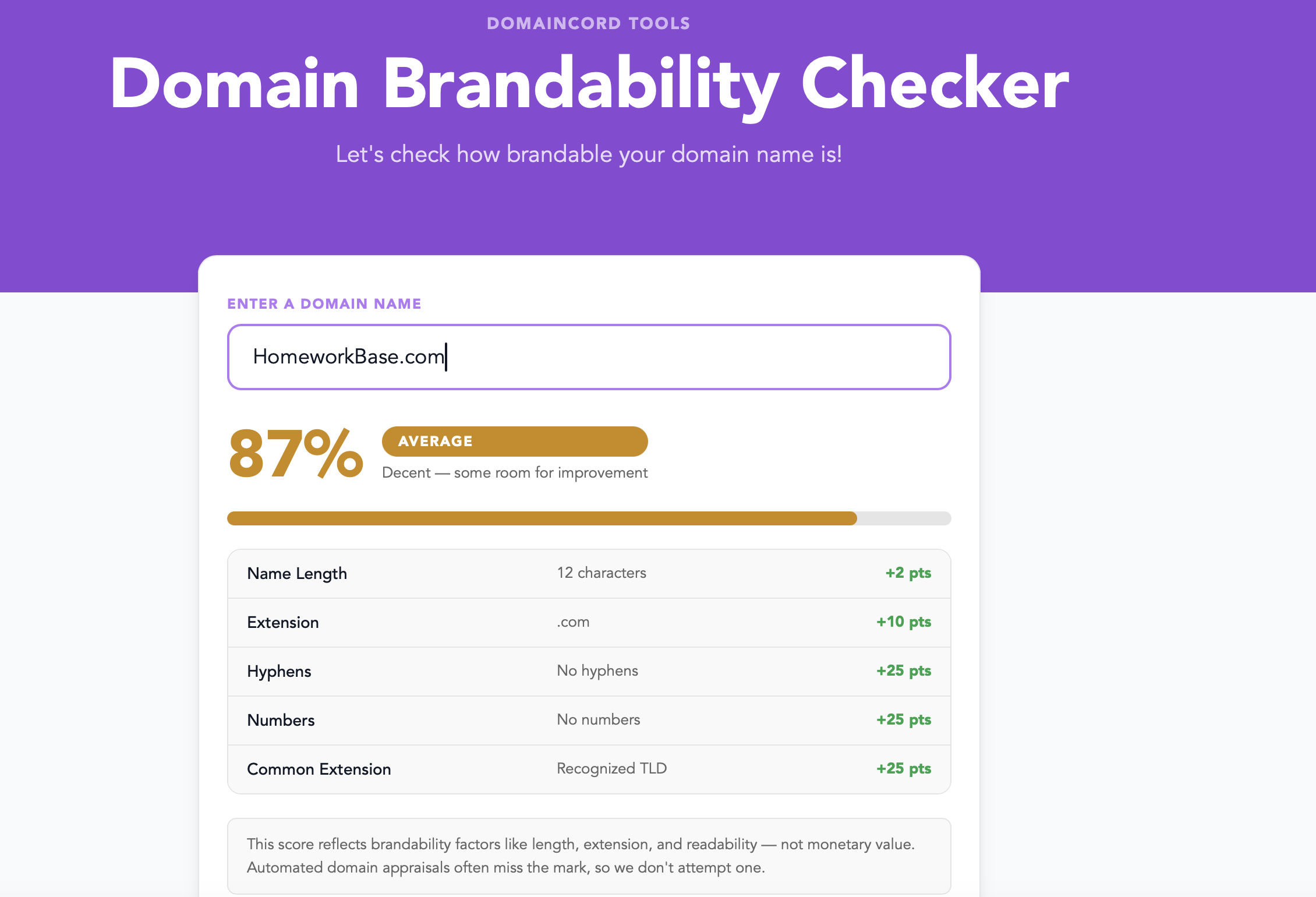
HomeworkBase.com scored 87%.
The score is slightly lower because the name is longer.
But the use case is very clear.
Possible buyer categories:
- tutoring platform
- homework-help product
- worksheet library
- student study app
- learning management tool
- parent education resource
- AI homework assistant
This is a useful reminder:
A slightly lower brandability score can still be interesting if the buyer thesis is clear.
For HomeworkBase.com, I would not stop at the score. I would check whether real businesses already exist in the homework-help, tutoring, and study-tool market.
Example 3: TimelyReminder.com
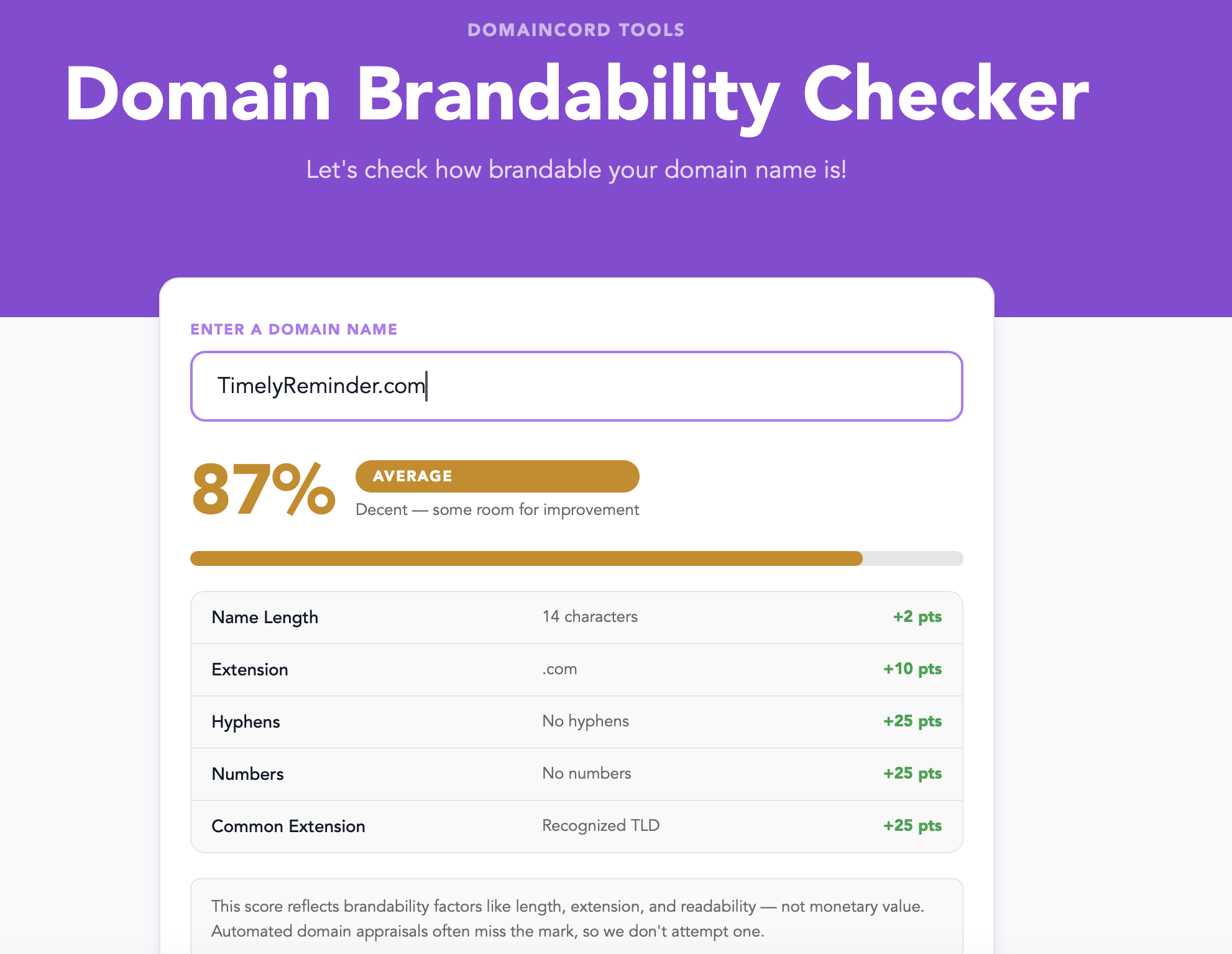
TimelyReminder.com also scored 87%.
The phrase is longer, but it describes a real workflow.
Possible buyer categories:
- appointment reminder SaaS
- CRM follow-up tool
- healthcare reminder system
- field-service notification product
- calendar automation tool
- payment reminder product
- customer retention software
This kind of name is not exciting because of pure brandability.
It is interesting because it points to a real business function.
The risk is that the reminder/notification market is crowded, so I would need to find a buyer angle that feels specific enough.
Step 2: Convert Brandability Into a Buyer Thesis
After a domain passes the basic brandability test, I try to write one buyer-thesis sentence.
The format is:
A [buyer type] would use [domain] because [business reason].
Examples:
A trail mapping app would use DigTrails.com because it sounds like a product for discovering and organizing outdoor routes.
A tutoring platform would use HomeworkBase.com because it sounds like a central place for homework support and student resources.
A CRM reminder product would use TimelyReminder.com because it clearly describes sending reminders at the right time.
If I cannot write this sentence clearly, I usually should not move forward.
Step 3: Build the Buyer List
This is the important part.
A domain can look brandable, but if I cannot find possible buyers, it is still risky.
For each domain, I want to find 10-30 possible buyers.
Places I would check:
- Google search
- LinkedIn company search
- Crunchbase
- Product Hunt
- app directories
- Google Maps for local or service categories
- existing companies using weaker domains
- similar keywords in live business names
For each possible buyer, I would ask:
- Does this company already sell something related to the domain?
- Would the domain improve their brand or product name?
- Do they have budget?
- Are they already using a worse or longer domain?
- Is the domain specific enough for them?
- Is the name too broad or too generic?
If I can find enough possible buyers, the domain moves into the outreach tracker.
If I cannot, I do not treat the domain as strong, even if the brandability score is high.
Step 4: Track Outreach Like Research Data
The outreach tracker should not only store who I contacted.
It should also teach me whether the original buyer thesis was correct.
Useful columns:
| Column | Purpose |
|---|---|
| Domain | The domain being tested |
| Buyer Category | The type of buyer I think fits |
| Company | Specific company name |
| Website | Current website/domain |
| Contact Source | Where I found the lead |
| Contact Person | Founder, owner, marketing lead, etc. |
| Contact Method | Email, LinkedIn, contact form, X, etc. |
| Status | Not contacted, contacted, replied, interested, rejected |
| First Contact Date | When outreach started |
| Follow-Up Date | When to follow up |
| Reply Notes | What the buyer said |
| Thesis Quality | Strong, medium, weak |
The goal is to make the outreach process measurable.
If nobody replies, maybe the domain is not as useful as I thought.
If people reply but say the name is not relevant, the buyer category may be wrong.
If people say it is interesting but not urgent, maybe the name is good but the timing is weak.
Step 5: Use Replies To Improve Future Filtering
Outreach replies are not only sales attempts.
They are feedback.
A few examples:
| Reply Pattern | What It Might Mean |
|---|---|
| "Not relevant to us" | Buyer thesis was too broad |
| "We already have a brand" | Better target early-stage products |
| "Interesting, but not now" | Domain may be useful but not urgent |
| "How much?" | Buyer fit may be real |
| No replies | Weak buyer list, weak message, or weak domain |
This is why I want to connect domain research with outreach.
The best filter is not only:
Does this domain look good?
It is:
Do real buyers react to this category of domain?
Final Takeaway
Brandability is useful, but it is only the start.
My current workflow is:
Brandability check
-> buyer thesis
-> buyer list
-> outreach tracker
-> reply feedback
-> better future filtering
A good domain is not only clean and memorable.
A good domain should also make it possible to answer:
Who could buy this, and why would they care?